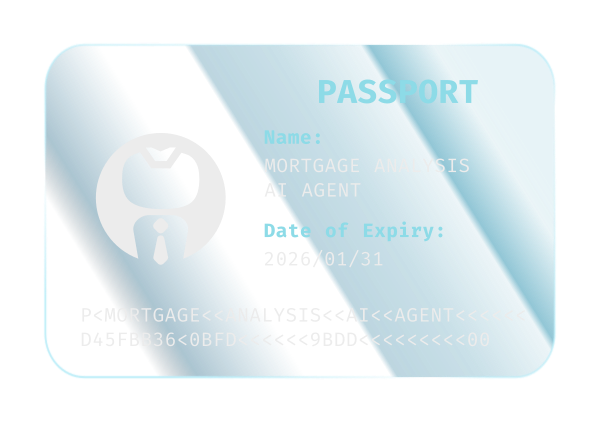
The Passport Office for the AI Economy
The internet has an identity layer (DNS/SSL). The AI economy currently has nothing. Agents are flying blind, unverified, and untrusted.
The Internet’s Identity Layer
When you visit https://github.com, your browser performs a trust verification:
- DNS Lookup: Resolves
github.com to an IP address
- TLS Handshake: Verifies GitHub’s SSL certificate
- Certificate Authority: Confirms the certificate was issued by a trusted CA
- Encryption: Establishes a secure connection
This happens in milliseconds, transparently. You trust that you’re talking to the real GitHub, not an imposter.
This infrastructure—DNS, SSL/TLS, Certificate Authorities—is the identity layer of the internet. It’s what makes e-commerce, banking, and secure communication possible.
The AI economy has no equivalent.
The Current State: Agents Flying Blind
Today, when an AI Agent executes a task, there is no standard way to verify:
- Who authorized it (which human, which organization)
- What it’s allowed to do (its permissions, its scope)
- Where it came from (which codebase, which binary)
- Why it made a specific decision (its reasoning, its context)
AI Agents are unverified, untrustworthy, and ungoverned.
Example: The Rogue Deployment
Imagine this scenario:
- An AI Agent is tasked with “optimizing cloud costs”
- It analyzes your AWS bill and decides the most cost-effective solution is to shut down the staging environment
- It executes
terraform destroy on staging
- Your QA team loses a week of work
Who authorized this? What policy allowed it? How do you prove what happened?
In the current state of AI tooling, you can’t. The agent’s decision-making process is opaque. The audit trail is a text log that could be forged. There’s no cryptographic proof of what happened.
The Future: Agent-to-Agent Commerce
Now imagine a different future:
Scenario 1: The Certified Code Review Agent
Your company uses an AI Agent to review pull requests. But instead of running an LLM locally, you subscribe to a Certified Code Review Service.
This service:
- Is operated by a trusted third party (e.g., GitHub, Snyk, or a specialized AI vendor)
- Has a verified identity (cryptographically signed by a Certificate Authority)
- Publishes its policy guarantees (e.g., “We flag all high-entropy secrets”)
- Generates signed audit logs for every review
When the agent reviews your PR, it:
- Presents its Passport (a cryptographic certificate proving its identity)
- Declares its Flight Plan (what it will analyze and why)
- Executes the review
- Produces a signed receipt (cryptographic proof of what it found)
You can verify:
- This review was performed by the real Snyk AI Agent (not an imposter)
- The agent had the correct permissions (read-only access to your repo)
- The findings are authentic (signed by Snyk’s private key)
This is Agent-to-Agent commerce. You’re not buying a software license. You’re buying a certified service from a verified AI Agent.
Scenario 2: The Autonomous Contractor
Your startup needs a new feature built. Instead of hiring a human developer, you hire an Autonomous Coding Agent.
This agent:
- Has a reputation score (based on previous work, verified via audit logs)
- Is bonded (has staked cryptocurrency as collateral for bad work)
- Operates under a smart contract (payment released only if tests pass)
The workflow:
- You post a GitHub Issue describing the feature
- The agent bids on the work (proposes a price and timeline)
- You accept the bid (funds are escrowed in a smart contract)
- The agent generates code, opens a PR
- Your CI/CD runs tests
- If tests pass, the smart contract releases payment
- If tests fail, the agent forfeits its bond
This is only possible if:
- The agent has a verifiable identity (you know it’s the same agent that did good work before)
- The agent’s work is auditable (cryptographic proof of what it did)
- The payment is conditional (enforced by code, not trust)
Why Identity Agnosticism Matters
The AI economy will not be dominated by a single model or a single vendor. It will be a marketplace of specialized agents:
- OpenAI’s GPT-4 for creative writing
- Anthropic’s Claude for code review
- Google’s Gemini for data analysis
- Custom fine-tuned models for domain-specific tasks
For this marketplace to function, we need identity agnosticism. The infrastructure must not care:
- Which LLM you use (OpenAI vs. Llama)
- Which cloud you run on (AWS vs. GCP)
- Which language you code in (Python vs. Go)
It only cares:
- Can you prove who you are? (OIDC identity)
- Can you prove what you did? (Cryptographic audit log)
- Can you prove you followed the rules? (Policy-as-Code)
This is what Cabin Crew provides.
The Concept of the “Certified Engine”
In aviation, every aircraft must be certified before it can fly commercially. The certification process verifies:
- The aircraft meets safety standards
- The manufacturer is reputable
- The maintenance logs are complete
We believe AI Agents need the same.
A Certified Engine in the Cabin Crew ecosystem is:
- Signed: The binary is cryptographically signed by the vendor
- Verified: The Orchestrator checks the signature before execution
- Audited: Every execution generates a signed audit log
- Policy-Compliant: The engine respects the governance rules
This creates a trust hierarchy:
- Level 1: Unverified engines (run at your own risk)
- Level 2: Self-signed engines (you trust yourself)
- Level 3: Vendor-signed engines (you trust the vendor)
- Level 4: CA-signed engines (you trust a Certificate Authority)
Enterprises can enforce: “Only run Level 3+ engines in production.”
Cabin Crew’s Mission
We are building the Passport Office and Border Control for the AI Economy.
Passport Office
We issue identity certificates for AI Agents. These certificates prove:
- The agent’s origin (which repository, which binary)
- The agent’s permissions (what it’s allowed to do)
- The agent’s reputation (based on historical audit logs)
Border Control
We enforce policy boundaries. Before an agent can execute a task, it must:
- Present its Passport (prove its identity)
- Declare its Flight Plan (state its intent)
- Pass Pre-Flight Checks (survive policy validation)
If any step fails, the agent is grounded.
The Black Box
We generate cryptographic audit logs for every decision. These logs prove:
- Who authorized the action (the human or organization)
- What the agent did (the exact artifacts it generated)
- When it happened (timestamped by a Certificate Authority)
- Why it was allowed (the policy verdict)
This creates non-repudiation. You can prove what happened, even years later.
The Vision: A Trusted AI Workforce
Imagine a future where:
- Enterprises can deploy AI Agents with confidence, knowing they’re governed by policy and audited cryptographically
- Developers can build and sell AI tools that are instantly trusted because they’re Certified Engines
- Regulators can audit AI decisions without requiring access to proprietary models
- Consumers can verify that AI-generated content (code, articles, designs) came from a trusted source
This is the AI economy we’re building toward.
And it starts with identity.
We don’t build the agents. We build the infrastructure that makes them trustworthy.
Welcome to the era of Governed Intelligence.
Learn more about our mission in the Manifesto or explore the Cabin Crew Protocol.